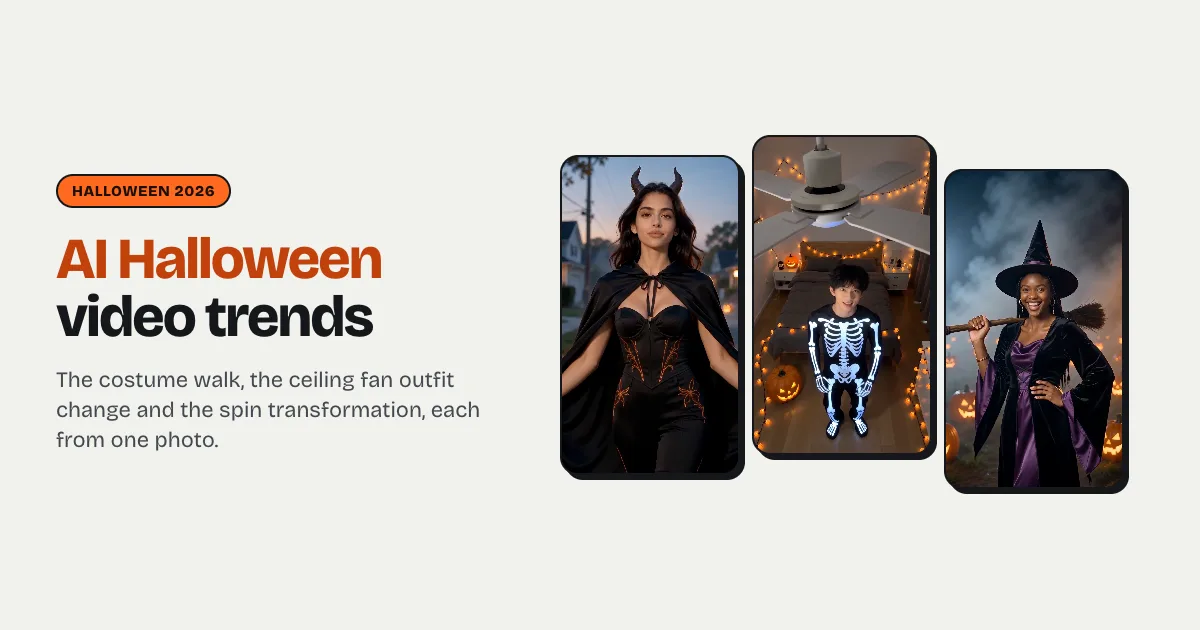


Short answer: the three AI Halloween video formats people are posting in October 2026 are the costume walk (the camera starts on your boots and tilts up to the full costume), the ceiling fan outfit change (every blade that sweeps past the lens puts you in a new costume) and the spin transformation (you spin in a swirl of sparks and land in costume). All three can be made from one photo on raindance-ai.org, in two to five minutes each, without buying a costume. The first video costs $3.99, then $7.99.
Which AI Halloween video should you make?
| Format | What happens | Best for | Make it |
|---|---|---|---|
| Costume walk | Low shot of boots and a swishing cape strutting down a street of jack-o'-lanterns, a slow tilt up the costume, your face last | The "reveal" crowd; looks like a real outfit post | AI Halloween costume video, Costume walk scene |
| Ceiling fan outfit change | One overhead shot under a spinning fan; each blade sweep switches you from everyday clothes to a witch, a vampire, then a glow-in-the-dark skeleton | "Which costume should I wear?" polls | Ceiling fan outfit change, Halloween looks |
| Spin transformation | You wave in your own clothes, spin once in orange sparks and land as a vampire, a witch or a skeleton | The classic before-and-after | AI Halloween costume video, Vampire, Witch or Skeleton |
All three come out as 8-second, 9:16 clips with an original spooky beat, no watermark, and your face kept from your photo.
The costume walk (the "slow reveal")
This is the Halloween format of the season on TikTok: people film their feet walking toward the camera to a strutting song, then tilt up to reveal the full costume. It works because the reveal is slow; nobody knows what you're dressed as until the last second.
The AI version does the camera work for you. Shot one is ankle height on a quiet suburban street at dusk, lined with glowing jack-o'-lanterns, fallen leaves and light fog: only boots and the hem of a long black cape. Shot two tilts up the costume, a sleek full-length black outfit with orange embroidery and a long cape. Shot three ends on your face, with small dark horns, a stop and a slow, confident smile.
Photo tip: a waist-up or full-length photo gives the model the most of you to keep.
The ceiling fan outfit change
The fan transition is a fashion format: someone films from the ceiling, looking down past a spinning fan, and changes outfits between takes so the blade hides every cut. Doing it for real needs a camera on the ceiling and a lot of retakes.
The ceiling fan outfit change makes it from one photo in one uncut overhead take. The Halloween looks set goes from everyday clothes to a witch with a tall pointed hat, a vampire with a high-collared cape and a glow-in-the-dark skeleton suit, one costume per blade sweep. There's also an Everyday to party set (hoodie, streetwear, a sparkly party look, an all-black evening look) for after Halloween.
Posting tip: ask "which one should I wear?" in the caption. Four costumes in eight seconds is a ready-made poll.
The spin transformation
The original transformation format: you wave at the camera in your normal clothes, spin, sparks wrap around you, and you land in costume and strike a pose. Each costume has its own setting:
- Vampire: a candlelit gothic party, a high-collared black cape lined with red.
- Witch: a foggy pumpkin patch at night, a tall pointed hat, a dark robe with purple accents and a broom.
- Skeleton: a house party under orange string lights, a glow-in-the-dark skeleton suit with face paint around your face.
What every version keeps (and won't do)
- Your face stays uncovered. No masks: the point is that people recognise you.
- Original costumes only. Characters from films, shows, games and brands aren't offered, which also keeps renders from being blocked.
- No blood and no weapons. Costumes are full-length, and gore isn't part of any version.
- One adult per photo. No photos of children: if you want a family Halloween post, make one clip per adult.
How to make one, step by step
- Open the AI Halloween costume video page (costume walk and spin) or the ceiling fan outfit change page.
- Upload one photo of yourself: face toward the camera, good light, waist-up or full-length.
- Pick the costume or the set of looks.
- Press Make and sign in with Google or an email. A standard clip is 10 credits: $7.99, or $3.99 for your first because the first credit pack is half price. A 5-pack ($24.99, or $12.49 as a first order) covers all three formats.
- Wait two to five minutes, download the MP4, and post it with the AI-generated label switched on.